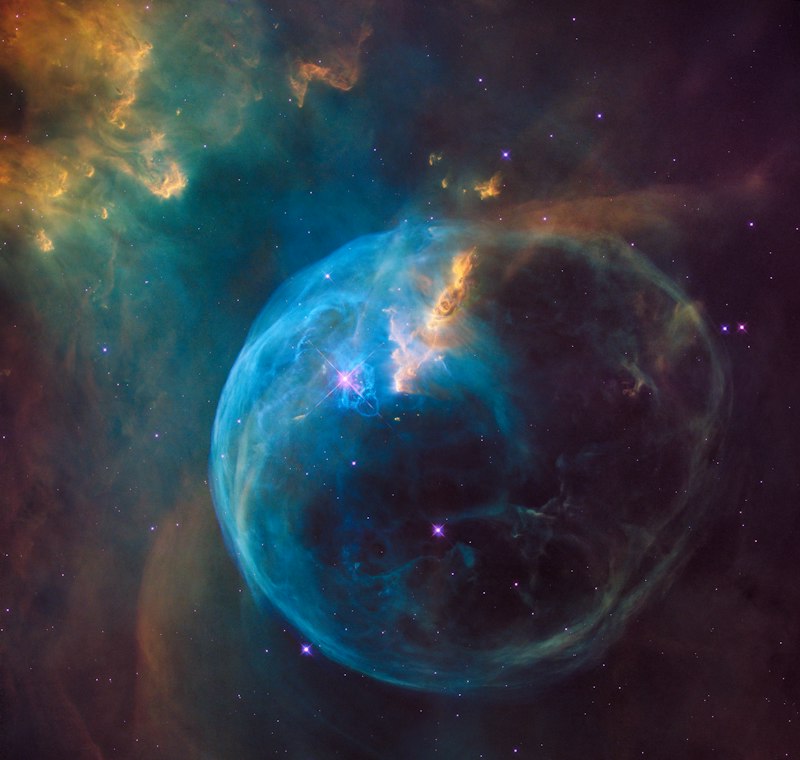
NASA’s Hubble Space Telescope has added another beautiful window into the deep universe: a visible-and-infrared view of the galaxy cluster MACS J1141.6-1905.
The cluster sits about four billion light-years away in the constellation Crater. In the new image, galaxies of different shapes gather around the center-left of the frame while brighter foreground stars show Hubble’s familiar diffraction spikes. It is the kind of space picture that works twice: first as wonder, then as data.
A picture that can keep working
NASA says the image includes observations from two Hubble programs that studied massive galaxy clusters bright in X-rays. Such clusters can act as natural cosmic magnifying glasses, gravitationally lensing more distant galaxies behind them and helping astronomers study parts of the universe that would otherwise be much harder to see.
The hopeful part is how long a mission like Hubble keeps giving. NASA notes that Hubble’s archive now holds around 1.7 million observations. Researchers can return to that archive with new questions and new tools, combining old light with fresh techniques to make discoveries long after the telescope first gathered the photons.
Wonder with a memory
Good science is not only the dramatic launch or the once-in-a-lifetime observation. It is also the patient preservation of knowledge so the next researcher, student or curious reader can find something new. This galaxy cluster is four billion light-years away, yet it is also part of a living library that keeps getting more useful.
Source: NASA, reporting on Hubble’s image of galaxy cluster MACS J1141.6-1905, its visible and infrared data, and the continuing value of Hubble’s observation archive.